Cesar Chavez: The making of an unperson
You might say it was like white Americans learning that George Washington, among other Founding Fathers, was a slave holder. In our present culture, that is evil.

Cesar Chavez was a hero in my pro-union household.
As the head organizer of California’s nascent National Farm Workers Association, Chavez had a national profile, and following, as he fought for basic rights for the physically and economically abused people who put so much of America’s fruit and vegetables on our table.
The plight of migrant agricultural workers had been known for a long time.
Sadly, The New York Times has revealed in a credible report that Chavez, who died in 1993, sexually abused women and even girls in his orbit.
You can find the gruesome details elsewhere, my focus is on the fallout.
The expose hurt many special-interest groups, such as unionists, farm workers, leftists, Catholics, and, of course, Hispanics.
You might say it was like white Americans learning that George Washington, among other Founding Fathers, was a slave holder. In our present culture, that is evil.
In the Inquirer, senior editor for commentary Sabrina Vourvoulias wrote “Chavez was a hero to many Latinos in a United States that officially honors precious few of us. Streets and schools were named after him, his face was on postage stamps and murals, and his birthday had become a U.S. federal commemorative holiday observed in seven states.”
Her op-ed details some of Chavez’s alleged crimes, explaining that one of the repeated victims remained silent for fear that accusing Chavez would bring ruin to her beloved union.
“One local friend messaged me Thursday morning to tell me he was planning to burn the posters and autographed ephemera his mother had collected during the many grape boycott actions she had participated in.”
She quoted Edgar Ramirez, the Mexican immigrant founder of Philatinos Radio: “Today we are pierced by a mixture of sadness, horror, and bitterness. Discovering the shadows of someone who was once an icon is painful, but disappointment does not paralyze us.”
Ramirez concluded: “We have learned that idols fall, but people rise up. This work is ours — it belongs to all of us, and to no one else.”
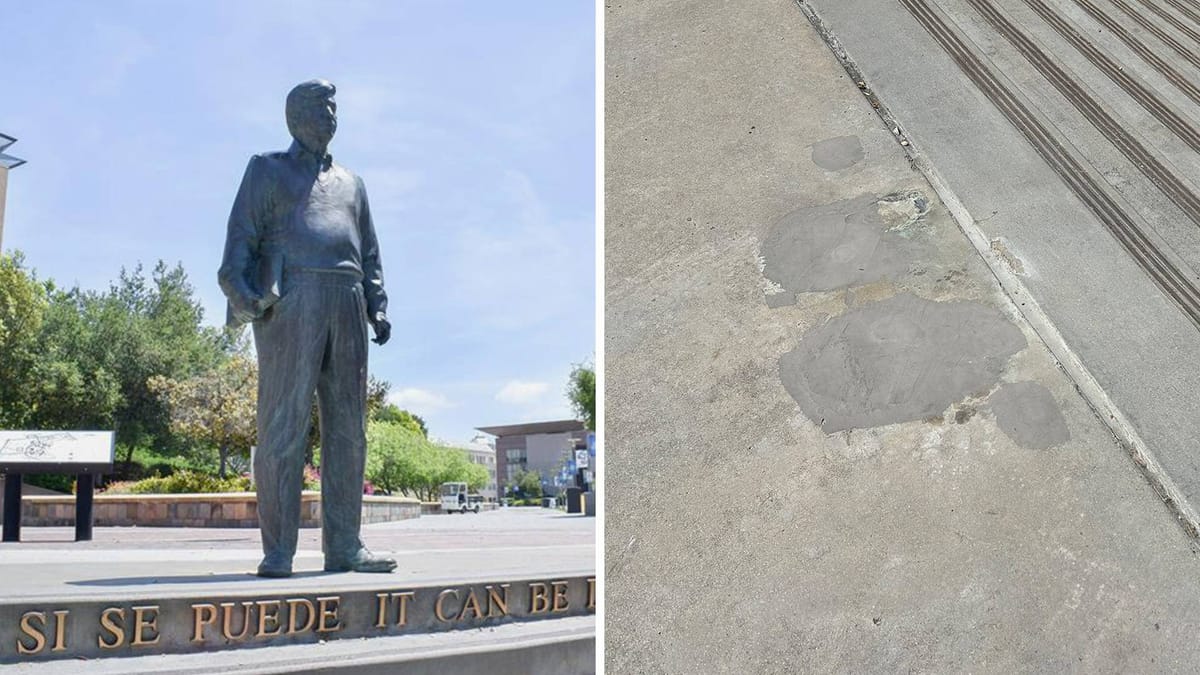
And, almost to reclaim what is theirs, there has been a nationwide spasm to scrub the public square of Cesar Chavez. Here we go again. For details, follow the link.
After reading her column, I emailed Vourvoulias a simple question:
Will you lead a campaign to rescind the 7 federal(?) holidays honoring Chavez, along with all statues in his honor?
She did not reply. I’m not surprised.
The correct answer, for her, as a member of the Inquirer’s editorial board, must be yes. The editorial board was in favor of removing statues honoring Christopher Colulmbus and Frank L. Rizzo.
But a “yes” would require courage and an unwavering moral philosophy.
The correct answer, for me, is no, do not remove it, despite him being a sexual predator.
For the same reasons I would not remove Columbus, Rizzo, or George Washington, Alexander Hamilton, Ben Franklin or other slave holders.
All were national historical figures whose life’s work of positive achievement far outweighed their serious flaws. That applies to Chavez.
This standard would allow removal of, say, Confederate generals who would not pass that test. Their overweaning accomplishment was treason.
Not all agree with me, nor do I expect it.
In Chavez’s case — as with Columbus and Rizzo — I would suggest a placard be placed near any statue, explaining the complete story, rather than to Wite-Out history.
That’s what, for instance, Wikipedia biographies do — they present the achievements alongside the failures.
It does not shove people down the “memory hole” invented by George Orwell in “1984.”
It is 2026. We should be able to deal with the duality of human nature.