Guest essay: Boomers went from analog to digital
They are the only generation in human history to have lived a fully analog childhood and a fully digital adulthood. No other generation will ever cross that particular bridge again.

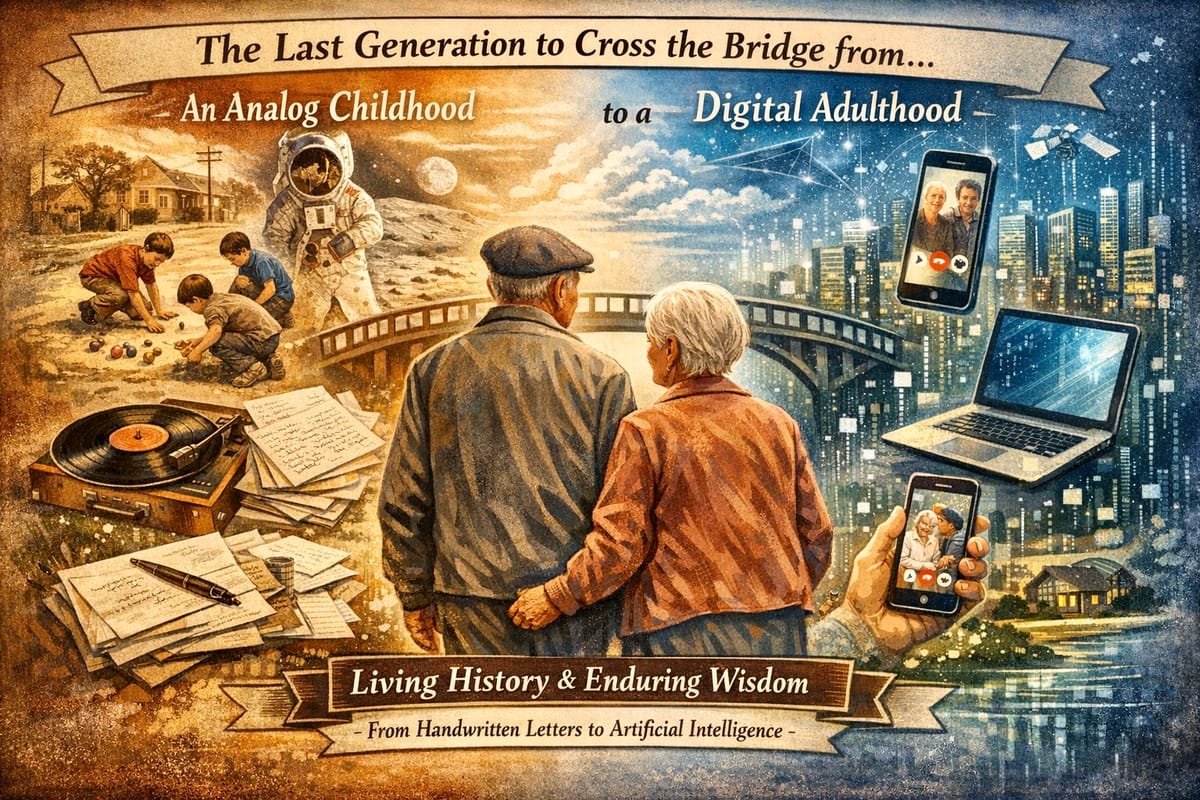
Posted on Facebook Baby Boomers Group
There is a generation alive today that most people quietly overlook.
They call them "the elderly." They offer them seats on buses, speak a little louder in their presence, and sometimes talk about them as if they are already half-gone from the world.
But look a little closer.
Because what you are actually standing next to is a living miracle.
These are the people who grew up without a single screen in their lives. They played marbles in dusty streets when the sun was still up and came home when the streetlights came on, because that was the only notification system the neighborhood had. They wrote letters by hand and then waited — sometimes weeks — just to hear back from someone they loved.
They are called Baby Boomers.
They felt the world hold its breath in 1969, sitting around flickering black-and-white televisions, watching a human being take the first steps on the Moon. Not on a phone. Not on a social media feed. On a grainy screen in a quiet living room, surrounded by family, in a moment that made strangers weep in the street.
They fell in love to vinyl records spinning on turntables. They raised children through the chaos of the 1970s and the ambition of the 1980s. They built careers with handshakes and patience, not LinkedIn profiles and algorithms.
And then — without being given a manual, without anyone asking their permission — the entire world changed around them.
Computers arrived. Then the internet. Then smartphones. Then streaming, messaging, video calls, and artificial intelligence that can hold a conversation. Machines that once filled entire rooms now sit in their pockets, lighter than a paperback novel.
And they adapted to all of it.
They are the only generation in human history to have lived a fully analog childhood and a fully digital adulthood. No other generation will ever cross that particular bridge again. Everyone born after them arrived in a world where screens were already waiting. Everyone born before them never had to make the crossing at all.
They survived polio scares, Cold War tension, economic crashes, and a global pandemic that shut the world indoors and reminded every generation that resilience is never truly optional.
And yet — despite everything that changed, everything that accelerated, everything that was lost and rebuilt and reimagined — they still remember what it feels like to sit across a table from someone you love, with no device between you, and just talk.
They remember the taste of a tomato picked from a garden.
They remember the sound of rain without needing to record it.
They remember what silence felt like before it became something people had to schedule.
That is not weakness. That is not irrelevance.
That is wisdom that the modern world desperately needs.
So the next time you see someone the world calls "elderly," take a quiet moment to recognize what you are actually looking at.
You are looking at someone who walked from the age of handwritten letters to the age of artificial intelligence — and never lost their humanity along the way.
They are not relics.
They are not footnotes.
They are the last living witnesses of a world that no longer exists, carrying memories that no algorithm can ever replicate.
And if you are part of this generation — if you recognize yourself in these words — then please hear this clearly:
You are not just growing older.
You are living history.
And that, quietly and without fanfare, makes you one of the most remarkable human beings who has ever walked this earth.