Guest essay: Greenland shows how Guam is screwed
President Donald J. Trump's pursuit of Greenland has prompted advocates to spotlight stark differences between how Denmark and the U. S. treat their territories, including Guam.

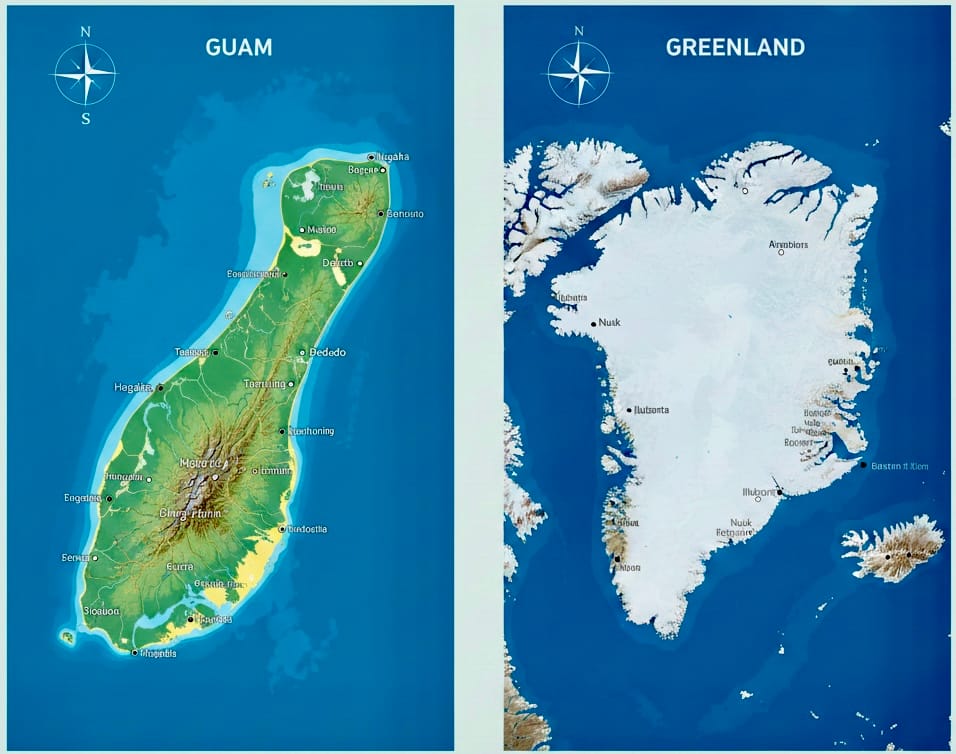
Adi Martínez-Román, co-director of Right to Democracy, said President Trump's recent statements about acquiring Greenland make the comparison urgent. She and fellow co-director Neil Weare published an article Tuesday in Just Security, a law and policy journal at NYU School of Law, examining Greenland's relationship with Denmark alongside the experiences of U.S. territories like Guam.
"Many people are very surprised at this approach from President Trump because they do not know that the U.S. already has an existing colonial framework, an existing territorial relationship with five places in a unilateral way," Martínez-Román said in an interview Thursday with The Guam Daily Post.
The Trump administration justifies deep-sea mining and national security interests in Pacific territories. Martinez-Roman said the arguments mirror those used when the United States first acquired territories more than a century ago.
"The discourse of national security, of resource extraction that are put forth by this administration are very reminiscent to the reasons why they acquired the territories in the first place and how they relate to them still to this day," she said.
Under Greenland's arrangement with Denmark, Greenlanders control all mineral rights and receive income from resource extraction. They also have voting representation in Denmark's parliament, receive yearly payments directly from the Danish government, and have a built-in option to pursue independence through a referendum.
People in Guam, the Commonwealth of the Northern Mariana Islands, and American Samoa have no say in deep-sea mining decisions affecting waters near their islands. The federal government has moved forward with mining exploration despite unified opposition from territorial leaders and tens of thousands of residents who submitted comments against the proposals.
"There is no guarantee of any benefits whatsoever, even if the United States ends up making billions of dollars from these leases," Weare said in an earlier interview with the Post about the mining issue.
The Just Security article notes that while Denmark's relationship with Greenland also has colonial origins, the evolution has been dramatically different. Denmark now recognizes Greenland's right to self-determination, with a legal path to pursue independence at any time.
Martínez-Román acknowledged that Denmark's relationship with Greenland has colonial origins, just as the United States acquired the U.S. Virgin Islands from Denmark in 1917. But she said the paths have diverged dramatically.
"The advancement or the evolution of that relationship with Denmark in Greenland has been exponentially different than how the relationship between the territories, the U.S. territories, and the federal government has stayed the same during all these years," she said.
The article notes that residents of U.S. territories pay more than $5 billion in federal taxes annually but often face exclusion or discrimination in programs like Supplemental Security Income, food assistance, and Medicaid. The federal government even prosecuted a disabled Puerto Rican man for mistakenly continuing to receive benefits after moving from the mainland to the island.
Martínez-Román said people in Greenland should understand the difference before considering any change in status.
"It may come out as a joke, but it is no joke that people in Greenland should beware about how the current U.S. territories are treated compared to how they're treated by Denmark, which is completely different," she said.
Trump's second inauguration coincides with the approaching 250th anniversary of the Declaration of Independence and the 125th anniversary of the Supreme Court's Insular Cases, which established the legal framework for treating territories differently from states.
"All this comes in such an important time where the U.S. is turning 250 years old, over a declaration of independence where consent of the government and all men are created equal are essential values," Martínez-Román said. "And that the insidiousness of this colonial framework that has existed (for) half (of that) history, 125 years, it's reflected again in these new attempts to acquire Greenland."
Right to Democracy will host a virtual panel Friday morning, Guam time, bringing together representatives from across U.S. territories to discuss what Greenland should know about territorial status. Former Guam Del. Robert Underwood will represent the island alongside panelists from the CNMI, American Samoa, the U.S. Virgin Islands, and Puerto Rico.
Martínez-Román said the organization continues working on the deep-sea mining issue, including outreach to territorial governors. Federal officials from the Bureau of Ocean Energy Management and the Department of Interior are scheduled to visit Guam on Feb. 25, though Gov. Lou Leon Guerrero will be attending a governors' conference in Washington, D.C., at that time.
The lieutenant governor is scheduled to meet with the visiting officials at 10 a.m. that day before they travel to the CNMI.
Martinez-Roman said the comparison shows how the United States uses justifications of national security and resource extraction both historically and today.
"It does not come as a surprise that this discourse is being used," she said. "It's just we want to make clear or illustrate to the people of the United States that do not know about how usual or how common the use of this language is when imposing things through the existing territory."
——
This appeared in the Guam Daily Post on Feb. 5, 2026