Is the middle class dead and gone forever?
In framing the book, Dickerson puts the spotlight on her own parents, who did break into the middle class, where Dickerson finds herself today.

Let’s start with an acknowledgement that America’s (envied and despised) middle class is suffering from thrombosis, and some have diagnosed it as terminal.
It’s not me saying it. Many books have been written on the subject such as this one and this one and this one.
Read them at your leisure. 🤓
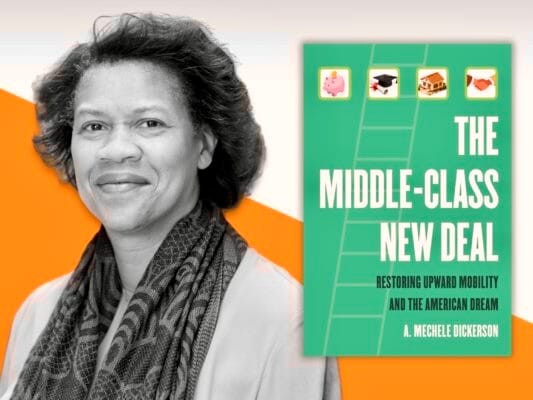
What I’ve just read is “The Middle-Class New Deal: Restoring Upward Mobility and the American Dream,” by A. Mechele Dickerson, an African-American lawyer who teaches at the University of Texas School of Law.
As both a lawyer and academic, the 270-page soft cover book — including 98 pages of notes, bibliography, index — can be as dry as a camel’s knees. There are endless passages laying out the dilemma of the middle class, which seems to have hit the rocks sometime starting in the go-go ‘80s.
There is a not-surprising overly-heavy focus on Black Americans, and I say overly-heavy because African-Americans are only 13% of the population, and are under-represented in the middle class for a number of historical reasons, most of which fit into the category of racism.
In framing the book, Dickerson puts the spotlight on her own parents, who did break into the middle class, where Dickerson finds herself today. And probably higher.
She dedicates the book to Warner and Arcola Dickerson, “who believed in the American Dream and who made me who I am.”
How did her parents do it?
By recognizing the “markers” of middle class success and diligently striving to achieve them — hard work, education, home ownership in a safe neighborhood, steady employment with benefits, savings, vacation time, and accumulating wealth.
Well, duh. Who don’t know that? you may be thinking.
Well, you may know that, but what you don’t know, and this is Dickerson’s thesis, is that since the 1980s our U.S. government — which created the middle class through post-Depression and post-WWII policies — has enacted policies that have built barricades to upward mobility.
These policies covered education, employment, housing, and finance laws. They have put the American Dream on the rotisserie.
Politicians today have disingenuously conflated the middle class with the “white lower rich,” which hides how state and federal lawmakers favor education, labor, housing, and consumer-credit laws that fall heavily on lower- and middle-income people.
Blending the latest research with personal stories from her own family, Dickerson shows how politicians have fashioned policies that consistently favor the privileged class. The book lays out a path to rebuild the middle class and expand opportunity for everyday Americans.
One problem: There is no universally accepted definition of middle class, so Dickerson makes up her own: Family income from $75,000-$130,000 in 2024.
“Since the 1980s, however, LMI [lower and middle income] workers have struggled to find permanent, full-time jobs with decent wages that offer benefits like health insurance and retirement plans,” she writes. “They cannot save enough to pay for unexpected emergencies, make a down payment on a home, or pay for their children to attend college.”
As for college, she asserts “a bachelor’s degree is the gateway to the middle class.” That seems to be a truism that is no longer true. Many Americans are recognizing that while a sheepskin is a gateway to the middle class, a solid blue-collar occupation, from automaking to HVAC, also open the door to the middle class, as defined by Dickerson.
Under the heading of KGOO — Keen Grasp Of the Obvious — Dickerson reports that wealthy neighborhoods have better schools, and better teachers. Why? Because the parents pay higher taxes to pay better salaries to better teachers and to fund extracurricular activities from sports to music programs.
And upper-income parents, she writes, have more disposable time as well as disposable income. They are more able, or more willing, to spend more time with their kids, than, say, a single mom working two jobs to get by. “By the mid-2000s, higher-income parents were dedicating nearly three times as much time to their children’s activities as other families,” writes Dickerson.
What is the cure?
You won’t be surprised: Spend more on what she calls the LMI — lower and middle income families.
But it’s not just money.
Her New Deal education plan calls for family friendly school policies, such as school hours that align with parents’ working hours, and schools being open all year.
Dickerson reimagines schools as purveyors not just of education, but also a range of community social services.
Her New Deal for employment calls for employers to again accept responsibility for their workers’ health insurance and pensions. “Today’s corporate executives no longer believe they have any obligation to help their workers realize their middle-class dreams,” she writes.
“While laws cannot force businesses to care about their workers, a bold New Deal Plan would force political leaders to stop enacting anti-worker legislation that prevents LMI workers from engaging in collective action to help them become and remain middle class,” Dickerson writes.
The New Deal Employment Plan, she writes, is devoid of exclusionary or racial biases. (Wouldn’t that ban DEI?)
Obviously, the book provides much more detail.
Her New Deal Housing Plan requires politicians to reject NIMBY demands for exclusionary nonzoning policies that prevent LMI workers from living in higher-opportunity neighborhoods. Housing unaffordability has reached record levels, and this must be reversed.
Although, she writes, having a stable home is more important than ownership, and the nation needs a greater stock of middle-income apartment rentals.
Gentrification must be neutralized through enlighted tax structures on current residents to prevent them from being swept away like broken glass in the street.
Her New Deal Debt and Savings Plan starts with forgiving education loans. I oppose this idea, flatly.
Restructuring debt to make it more manageable, sure.
She also says students should be taught the importance of savings, and also breathing. (I am kidding about breathing.) She endorses having students engage in stock market games, online videos and online financial games.
Who’d oppose that? No one who ever played Monopoly.
Dickerson closes with this frightening assertion:
“The middle class, as we knew it, is gone.”
Is she right? If so, can it be brought back?