Memo to one and all: It IS a Christmas tree!
If I follow the dictates of PC, I’d be lighting candles on a holiday candelabra, not on what it actually is — a Hanukkah menorah.


I’m willing to call it what it is — anti-Christian bigotry.
If you are unable or unwilling to call it what it is, a Christmas tree, you are a bigot.
Cultural appropriation is defined as members of one society, typically more dominant, adopting the customs, practices, ideas, etc., of another people.
Can we call it cultural destruction when one group’s symbol — a Christmas tree, for example — is deliberately “misgendered” to obscure its religious roots because it might make some other, never-named, group feel “uncomfortable”?
I ask because I have been having a skirmish with some PC or Woke folks on Facebook who can’t understand why I insist on calling a Christmas tree a “Christmas tree,” and not a “holiday tree,” as the one outside City Hall is called.
What “holiday” are we talking about? I ask. The tree is a specific symbol of a specific holiday. That holiday has a name. What is it? [Spoiler alert: Christmas!]
Some of the Woke reply that all cultures celebrate a winter solstice. Not all, but OK. And the ones that do should be given agency to call them what they want, and use whatever symbols they wish.
Like Kwanzaa, for instance.
It’s a holiday invented in 1966 by Dr. Maulana Karenga to celebrate African-American and Pan African culture.
Hmm. Doesn’t sound that inclusive to me, and it’s got a foreign name. Very off-putting, How about if we rename it the December Breaks?
Then there’s Hanukkah, all eight nights of it. Another foreign-sounding name that might frighten some Americans. Fortunately, it comes with a subtitle, the Festival of Lights. (Not to be confused with Seinfeld’s Festivus.)
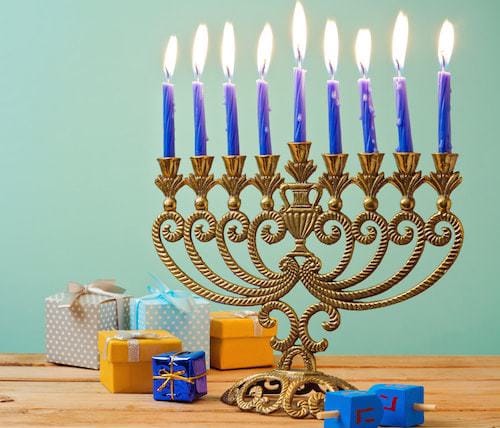
If I follow the dictates of PC, I’d be lighting candles on a holiday candelabra, not on what it actually is — a Hanukkah menorah.
Get it — Hanukkah menorah, not holiday candelabra.
Christmas tree, not holiday tree, which is an avoidance of fact, a deliberate obfuscation. An anti-Christian term.
Yes, Christmas is a Christian holiday, which is religious. It celebrates the birth of Jesus, and by all accounts he was a pretty likable man, preaching peace, feeding the masses, raising the dead and the rest. Well, likeable except for the Romans. But let’s not get bogged down.
Christmas is also a federal holiday, which makes it secular.
You don’t have to be Christian to enjoy Christmas. I’m not Christian and I’ve always enjoyed it, more for the family gathering and gift-giving than for the birth of a Jewish baby in a Bethlehem manger.
I don’t follow his Disciples, but I do follow his principles, as best I can, although I am not a turn-the-other-cheek kind of guy. That’s why I am fighting for Christmas trees on Facebook.
Not because I believe that Jesus was the son of God, but because I believe a Christmas tree symbolizes Christmas, no other holiday. That is a fact and I am fact-driven.
—-
I bring you back to a 2010 controversy, when the city (actually Woke managing director Rich Negrin) tried to cancel the “Christmas” from the Love Park Christmas Village.
Rather than telling you the story myself, I will let Gemini AI do it:
Stu Bykofsky, a longtime and often provocative columnist for the Philadelphia Daily News, was one of the most vocal critics of the city's decision to rename the Christmas Village.
True to his “tell-it-like-it-is” style,” Bykofsky’s response centered on the idea that the name change was an example of "political correctness gone wild." Here are the key points he made during the 2010 controversy:
• The "Federal Holiday" Argument: Bykofsky argued that Christmas is a legal federal holiday in the United States. He mocked the idea that the word itself could be considered offensive or "un-inclusive" on public property, since the government officially recognizes the day.
• The "Grinch" Label: He famously characterized the city's decision-makers as "grinches" and "cowards" for caving to what he viewed as a tiny minority of complaints.
• Defense of Tradition: He wrote that the market was modeled after traditional German Christkindlmarkts, which are inherently religious and cultural celebrations of Christmas. He argued that stripping the name was an insult to the heritage of the event itself.
• Mockery of the Compromise: When the city briefly removed the word "Christmas" and left the sign simply saying "Village," Bykofsky ridiculed the absurdity of having a nameless village, suggesting it was a sign of a city government that didn't know what it stood for.
His columns played a significant role in fueling the local outrage that eventually led Mayor Michael Nutter to reverse the decision just a few days later. Bykofsky later took a "victory lap" in his writing when the "Christmas" signs were restored, framing it as a win for common sense over "PC" culture.
Damn, that AI was good. Even spelled my name right.
On Facebook, someone said I was engaging in the fake “war on Christmas” that was hot about a decade ago, and asked if this was the hill I wanted to die on.
I replied that this wasn’t a war for or against Christmas, it was a war on common sense, truth and reality and, yes, that is a hill I will die on.
Tomorrow is Christmas — not some arbitrary winter holiday — and I wish everyone a most happy and very merry Christmas.