Philly Joy Bank dishes out cash to pregnant women
This pilot program plays out against the larger backdrop of a universal basic income.

I don’t believe in free money. There’s no such thing as a free lunch; someone always has to pay.
In the case of the Philly Joy Bank, those who pay are philanthropic organizations and city government, to the tune of $6.3 million.
The Philly Joy Bank?
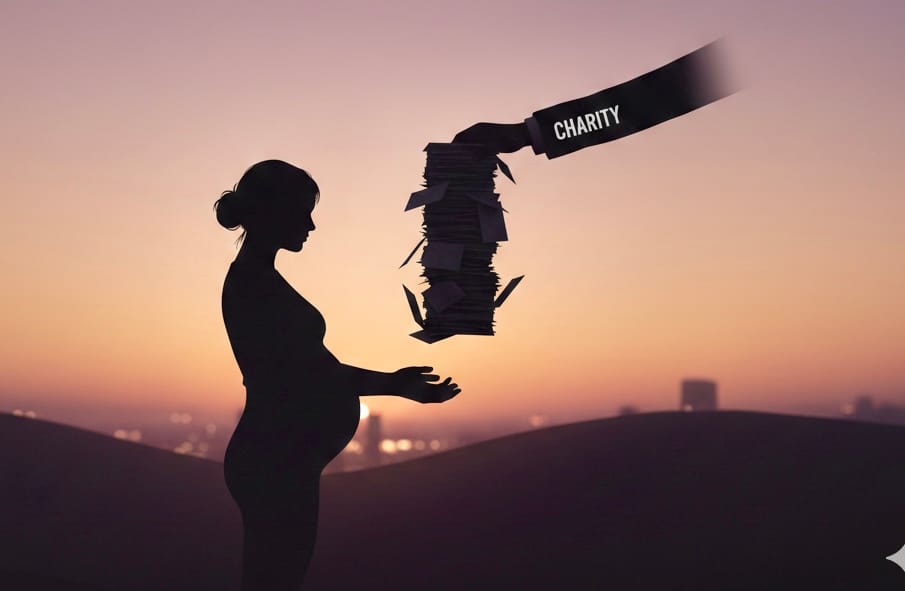
It was launched in 2024 with a goal of providing 250 “birthing people” with $1,000 a month for 18 months. Recipients, who were chosen by lottery, had to be in 12-24 weeks of pregnancy.
Sounds like free money. [Bonus for music fans online: Dire Straits “Money for Nothing,” click here.]
Well, it is, but it has a purpose, at least that’s what philanthropic funders such as the William Penn Foundation, Vanguard, Pew Charitable Trusts, and the Jewish Healthcare Foundation believe. (The amount given by charities is not public.)
The guaranteed annual income is a pilot program here, but has been experimented with in a few other cities, as reported in 2024 by Axios.
Women also are offered voluntary assistance such as financial counseling, home visits, doula help, and lactation support.
The purpose is to bring down infant mortality, which is 1.8 per 1,000 births, which is 40% higher in Philadelphia than the national average. Black infants here are twice as likely to die than white infants, according to Nia Coaxum, program manager of Philly Joy Bank, or PJB.
That is a sobering, if not a horrifying, statistic.
I ask Coaxum how the name Philly Joy Bank was chosen.
“This is a community co-designed and co-led program,” she starts, “and we have a steering committee of multi-sector representation that includes maternal health organizations, researchers, folks from academia and community members that we call lived experience experts.”
That means it was a mutual decision by stakeholders, to “emphasize joy that comes with pregnancy and parenting,” Coaxum adds.
Since PJB is designed for “birthing people,” I had to ask how many of the 250 participating birthing people are male?
Zero. So much for woke terminology.
I will refer to the participants as women.
The pregnant women were selected from three predominantly Black, low-income Philadelphia neighborhoods — Cobbs Creek, Strawberry Mansion, Nicetown-Tioga — that had the highest percentage of low birth weight, says Coaxum, “which we were using as a proxy for premature birth, which is the leading cause of infant mortality.” The program’s goal is “to improve birth outcomes,” she says.
We won’t get the results until next year, when the outcomes will be boiled down by Drexel University researchers.
We are chatting in the Department of Health offices at 1101 Market, now known as the Jefferson Center, but better-known to older Philadelphians as the Aramark Tower. From the offices on the 13th floor, we look down on a city that’s encased in ice, but with a heart that is not.
The $1,000 a month stipend lasts 18 months — to cover pregnancy, “and then up to one year postpartum, so throughout the baby’s first year of life,” Coaxum tells me.
The cash is handed out with no strings attached.
“That respects the dignity and autonomy of participants,” says Coaxum, “allowing them the freedom to use the cash as they see fit to address their needs.”
The idea seems to be that mothers are the best judge of where and how the money should be spent, and I hope that is true. Half of the women have annual incomes of less than $10,000, the next quarter have incomes of less than $25,000. The city did not ask about support from fathers.
I ask to speak to a few of the women recipients, but none were willing, according to James Garrow, deputy commissioner of the Department of Public Health, who sat in on the interview.
He did offer a couple of quotes from recipients:
“This program really has blessed me . . . Not only can I get gas, but I can get stuff for a new baby girl. . . I can get food when my food stamps run out.”
And
“My kids now have space . . . Not a forever home, but a step up.”
On the PJB website, other mothers speak.
PJB fits the definition of a village raising a child, says Aisha. “There’s a lot of great team members that I met so far that’s been helpful towards me.”
Ciara adds, “No program I know of it like this. They not pumping you for information. . . They just wanna give you the support that you need.”
This pilot program plays out against the larger backdrop of a universal basic income.
This became a national issue in 2020 when presidential candidate Andrew Yang proposed a $1,000-a-month “freedom dividend” to every American adult.
The ultimate in free money.
But Yang was suggesting it as a cushion for Americans displaced by automation. Robotics and AI have become significantly more scary since then, with some estimates predicting as many as half of white-collar entry-level jobs will vanish in the not-so-distant future.
It could be less, it could be more.
A free lunch might be in many of our futures.