Riley: Affirmative action actually hurts black people
Without remorse, he parades a stunning set of statistics to prove, in his view, that blacks did better before affirmative actions, than after. In life, in education, on the job.

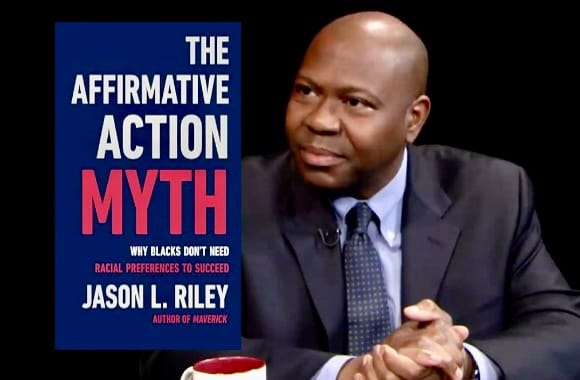
Not exactly to celebrate Black History Month, I picked up “The Affirmative Action Myth: Why Blacks Don’t Need Racial Preferences to Succeed,” by conservative Black journalist Jason L. Riley.
How does he feel about affirmative action? From the midpoint of the 280-page book:
“On balance, racial preferences have been ineffective in helping the most disadvantaged black Americans. [Riley does not capitalize black.] Affirmative action has slowed whatever previous black progress was already occurring, while giving blacks and whites alike the impression that black people are charity cases dependent on government programs.”
Nasty letter to follow.
I know this subject is particularly touchy now, as employers across the board are diluting or reversing hasty Diversity, Equity, and Inclusion guidelines rolled out after the murder of George Floyd.
“The reality is that black people essentially lifted themselves out of poverty in the first two-thirds of the 20th century — before affirmative action,” writes Riley, who says a lot of his thinking and research flowed from columns on the subject he wrote for The Wall Street Journal.
“The main purpose of this book is to explain how affirmative action has failed,” he states.
Failed. Wow. That is controversial.
His research is overwhelming. It is mercilessly detailed with 21 pages of footnotes in type as tiny as ant droppings quoting endless reports and research done by a galaxy of historians, social studies professors, writers, and other academics, black and white, liberal and conservative.
Without remorse, he parades a stunning set of statistics to prove, in his view, that blacks did better before affirmative actions, than after. In life, in education, on the job.
Which proves, in his opinion, that affirmative action sucks. He sees it as a placebo.
He says he is not alone, citing a 2001 survey conducted by the Washington Post, the liberal Kaiser Family Foundation, and Harvard University.
Riley says that 92% of all respondents and 86% of blacks said that decisions on college admissions, hiring, and promoting “should be based strictly on merit and qualifications other than race/ethnicity.”
There is irony here in that one of the three survey sponsors, Harvard, 20 years later was found by the U.S. Supreme Court to have violated the Constitution by using race in college admissions.
If the Left was shocked and dismayed by that decision — and it was — followup reporting by the liberal Washington Post was even worse. In covering an Economist/YouGov survey, the Post reported that only 20% of blacks said they were helped by affirmative action, while 35% said “they felt such policies had put them at a disadvantage.”
That’s kind of a smell-the-coffee moment.
And I am certain it is challenged by progressives. There is no question the outcome of polls is subject to the wording of questions, to the accuracy of the sample, and other factors.
Affirmative action was invented to help minorities, and when it didn’t, everyone was afraid to say so for fear of being labeled a racist, Riley writes, and provides a few examples from academics.
He bristles at the idea that black people can’t succeed without preferences. He reminds me of a George W. Bush quote about “the soft bigotry of low expectations.”
Racism may be a factor in hindering black advancement, Riley writes, but it is not the factor.
How does he know that?
Because other people of color have more wealth than whites. “Americans of Chinese and Japanese descent outperform whites both academically and economically,” he writes. Income for Indian Americans and Korean Americans exceed those of whites.
“Racism still exists, and I don’t expect to live to see the day when it doesn’t,” he writes. “The relevant question is to what extent does past or current racism, in whatever form it takes, explain ongoing racial disparities.”
The key to success, he says, is education. Nothing controversial about that.
But race-based admissions at elite universities hurt black students who are academically unprepared for the rigor of, say, Harvard, says Riley. Black students have higher achievement at, say, most Historically Black Universities and Colleges.
“Duting the first two-thirds of the 20th century, well before affirmative action and an expanded welfare state supposedly came to the rescue, black people experienced significant progress," according to Riley.
“Education gaps narrowed, income rose, and poverty declined. This history hasn’t received the attention it deserves because black politicians and activists have a vested interest in a narrative that accentuates black suffering,” he says.
“Racial gaps in the 21st century are regularly blamed on racism and the legacy of slavery and segregation,” writes Riley. “But there was no shortage of racism in the 1940s and ‘50s, when racial gaps were narrowing by almost every significant measure.”
Riley believes black progress came faster “when the focus has been on equal treatment rather than special treatment, when intact black families were more common, when poor black neighborhoods had lower rates of violent crime, and when the welfare state was smaller.”
These are traditional conservative viewpoints.
But nothing is as cut and dry as partisans would have you believe.
Do I agree with Riley, that affirmative action is actually negative?
Which affirmative action do you mean — the one that assures equal opportunity, or the one that tries to create equal outcomes?
I am for the former, against the latter, which Riley argues is what affirmative action became, despite assurances that it would not.