The most exclusive club in the world
After his election, Bill Clinton found a full house — Richard Nixon, Gerald Ford, Jimmy Carter, Ronald Reagan, and George H.W. Bush.

We know that some dogs and cats can become friends, but nothing was more surprising than the genuinely close relationship that developed between Presidents George H.W. Bush, the man who led America’s most successful war, and Bill Clinton, the draft dodger who vanquished him.
Their “father-son” relationship was one of the many curiosities revealed in the massive best-seller “The Presidents Club, Inside the World’s Most Exclusive Fraternity,” written by the excellent Nancy Gibbs and Michael Duffy.
If you like history and politics (and you have a lot of free time) this is for you.
I knew there was a Presidents Club, of sorts, which I thought was just an informal loose network of former chief executives. I had no idea the club has an actual government-supplied “club house" in D.C., at their disposal.
The authors explain that no matter how different their policies and personalities, they share (as Presidents) an experience understood by no one else on earth. While each seeks to burnish his own legacy, each will usually come to the aid of the office of President, irrespective of the man — only men so far — who occupies it.
Not that long ago, the club had its greatest number of members — ever.
After his election, Bill Clinton found a full house — Richard Nixon, Gerald Ford, Jimmy Carter, Ronald Reagan, and George H.W. Bush.
“Not all of them had been helpful to one another, in or out of office. But some combination of his charm, their needs, and the new global challenges of the post-Cold War age allowed Clinton to deploy nearly all to his advantage — especially, as it turned out, the Republicans,” write the authors.
Counting the massive number of pages devoted to notes, a bibliography, and an index, the book runs 641 pages. I tell you that to explain why it is difficult to summarize the book, and the Presidents.
Here are my thumbnail impressions of the Presidents, and I freely admit I am influenced by personal bias.
By the account of other Presidents who employed him on missions, Jimmy Carter was the least trustworthy, most egotistical, least humble of them all. He repeatedly exceeded the perimeters of his missions, and then stepped into a self-serving spotlight to announce his achievements to the media before reporting to the President he served.
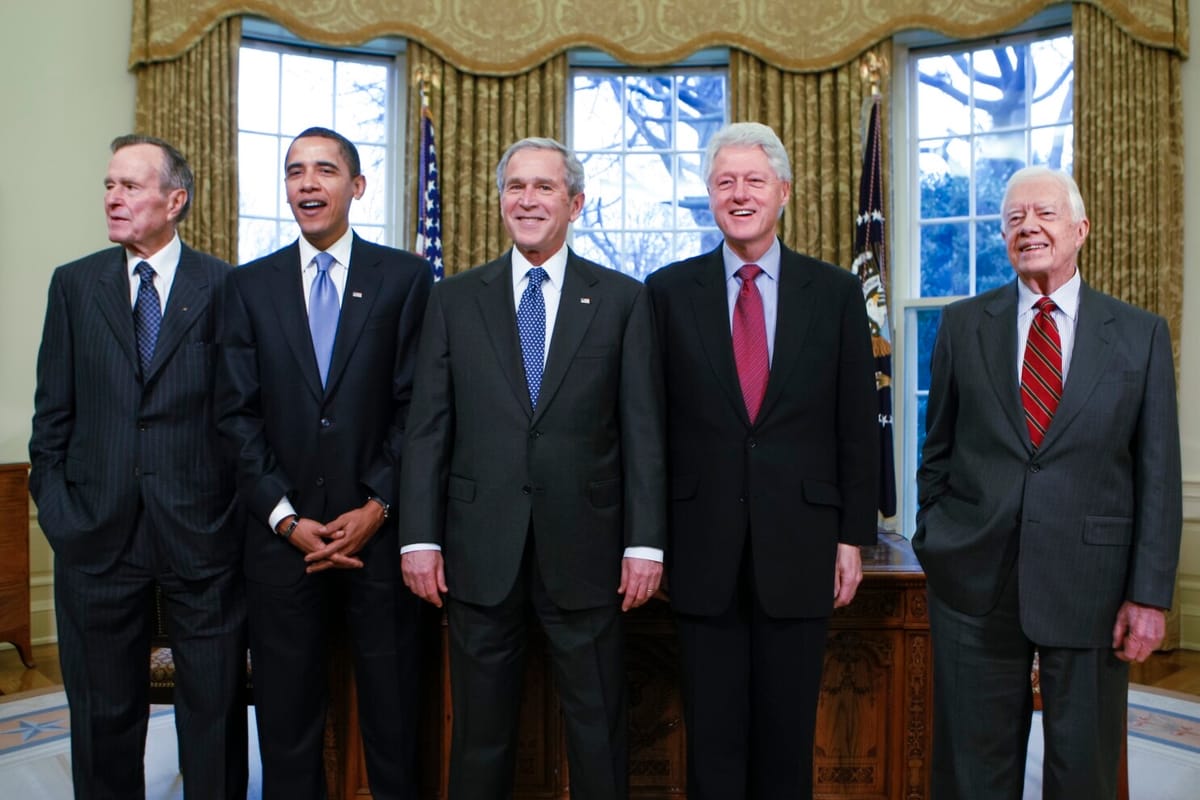
There is one telling picture in the book: Taken in President
George W. Bush’s Oval Office, George H.W. Bush, Barack Obama, President Bush, and Bill Clinton are all standing shoulder to shoulder. Jimmy Carter is standing a foot away from the group. It’s just a moment in time, but it speaks symbolically. And, yes, I dislike Carter, an ineffectual, micromanaging goober.
Did I say Carter is less trustworthy than, say, plumber's unit boss Nixon, a known liar?
Yes.
Fun fact: Kennedy and Nixon both entered Congress in 1946, each having been a Naval officer. Each was a reformer and a passionate anti-communist.
Clinton perhaps inadvertently rehabilitated Nixon from his Watergate infamy by using him on diplomatic missions, and considered him the most knowledgeable American when it came to dealing with adversaries Russia and China. He leaned on him heavily, and Nixon was thrilled to return to a plateau of significance because he was horribly needy, or thirsty, as the kids say.
Gerald Ford was the former President who always put the needs of the nation before party, and before his personal feelings. He was a rock.
Ronald Reagan was pretty much out of it mentally by the time he left office, and he retreated to his ranch in the West. He may have been born in Illinois, but he became an American cowboy, who loved riding his horse alongside his devoted wife, Nancy. He is generally credited with winning the Cold War and is usually listed by historians in the Top Ten Presidents.
Don’t tell Inquirer columnist Will Bunch, who has spent decades in a fruitless effort to destroy Reagan’s image.
The elder Bush was in an unusual position, having had the highest ratings imaginable after his coalition under Operation Desert Storm drove Iraq out of Kuwait in 100 hours, and then the World War II fighter pilot losing the presidency to draft dodger Bill Clinton, who had to be taught how to execute a military salute. (By former President Ronald Reagan.)
Bush’ patrician sensibilities led him to step back, and to never criticize the man who beat him. Likewise, his son, George W., after the Oval Office, retreated to his ranch, and painting, resolved to steer clear of partisan politics. Both Bushes were admirable in this regard.
In recent years, Barack Obama has largely chosen to follow this example.
Clinton, having practically adopted the senior Bush as the father he did not have, then fashioned a fast friendship with W, with the Bush family referring to Clinton as a brother from another mother.
Earlier, Clinton had bonded so tightly with Nixon that when he died, Clinton said he felt like he did when losing his mother.
I can’t imagine Donald J. Trump having — or even wanting — such a friendship with anyone, but I do remember that Barack Obama engaged in friendly conversation with Trump at Carter’s funeral.
—-
I will close with an observation that may piss off both Left and Right: the character traits shared by JFK and The Donald.
Kennedy had “faith in personalities over protocol,” wrote presidential advisor Clark Clifford. You can easily see that same preference in Trump, by whom he chooses to surround himself.
“They behaved as though history had begun with them,” wrote Clifford of JFK’s team. They regarded their predecessors “with something bordering on contempt.” Ever listen to how Trump talks about Joe Biden? That border on contempt has been shredded.
JFK also leaned hard on family, as does Trump.
Unlike Trump, Kennedy could admit a mistake.
Kennedy entered the Oval Office with the arrogance of youth, but soon found himself turning to his predecessor, World War II hero Eisenhower for advice.
Fun Fact: President Eisenhower was buried in military uniform and in an $80 government-issued casket he requested.
Seeking Presidential advice is a continuing theme of the book.
Bill Clinton entered office as a know-it-all, but soon found there was so much he did not know. He had the smarts, and the humility, to turn to the Presidents Club for help.
Harry S Truman didn’t have that resource when the liberal establishment turned against the “accidental President” when he faced election in 1948, having become President after the death of Franklin D. Roosevelt.
Presidential advisor Clark Clifford said Truman “had met every liberal test that existed in that period and here was supposedly the professional liberal organization” that lined up against FDR’s hand-picked successor.
As we know, the plucky Midwesterner had the last laugh.
“If the Presidents Club had a seal,” the authors write, “around the ring would be three words: Cooperation, competition and consolation.”
The rest of us, no matter how stressful and anxious our lives, will never experience anything like it.