The past is not so far away
I remember when “the cloud” was just something you worried about ruining a picnic

I’ve been alive forever, and I wrote the very first song.
Um, no, that was not me. That was Barry Manilow singing Bruce Johnson’s lyrics to “I Write the Songs.”
Comic Nate Bargatze — who works super clean and is superfunny — said something on a recent Netflix special that set my mental wheels spinning.
He was talking about how long he has lived. (He’s 46.)
I started to do the same, and came up with this: I have lived in nine decades — ‘40s through ‘20s.
I have lived in two centuries — the 20th and 21st.
I have been alive in two millenia — the 1,000 and the 2,000. (I had fun covering the arrival of the new millennium on New Year’s Day, 2000.)
And — get this — I have been alive for one-third of America’s history. My father lived through almost half of American history.
Which underscores what a young country we truly are. Or maybe how old I am.
Age is just a number, say old people. Young people only say that when they are underaged and trying to get into a bar.
You can run your own numbers to see how you match up with the nation. If you are older than 26, you, too, have two centuries and two millenia in your account.
Remember “don’t trust anyone over 30”? Everyone who said that is now over 60.
Some things change slowly, like language. Some things change fast, like science.
Modern humans have been around a long time. It took them 300,000 years to achieve powered flight — Wright brothers, Kitty Hawk, N.C., 1903. In 1969, just 66 years later, we landed on the moon. That is faster than a blink in Time’s eye.
The first commercial digital computer, UNIVAC, came online in 1951. It was 14.5 feet long, 7.5 feet wide, 9 feet high. In 2007, the iPhone appeared, with more computing power in your hand, than UNIVAC offered.
Slavery. Perhaps 100,000 people who were enslaved were still alive when my father was born in 1916.
My father’s life overlapped with people who had been enslaved. Mine overlaps with people who were sentenced to polio wards encased in Iron Lungs. The past isn’t as far away as we like to pretend. It lingers in memories, in habits, in systems we’re still untangling.
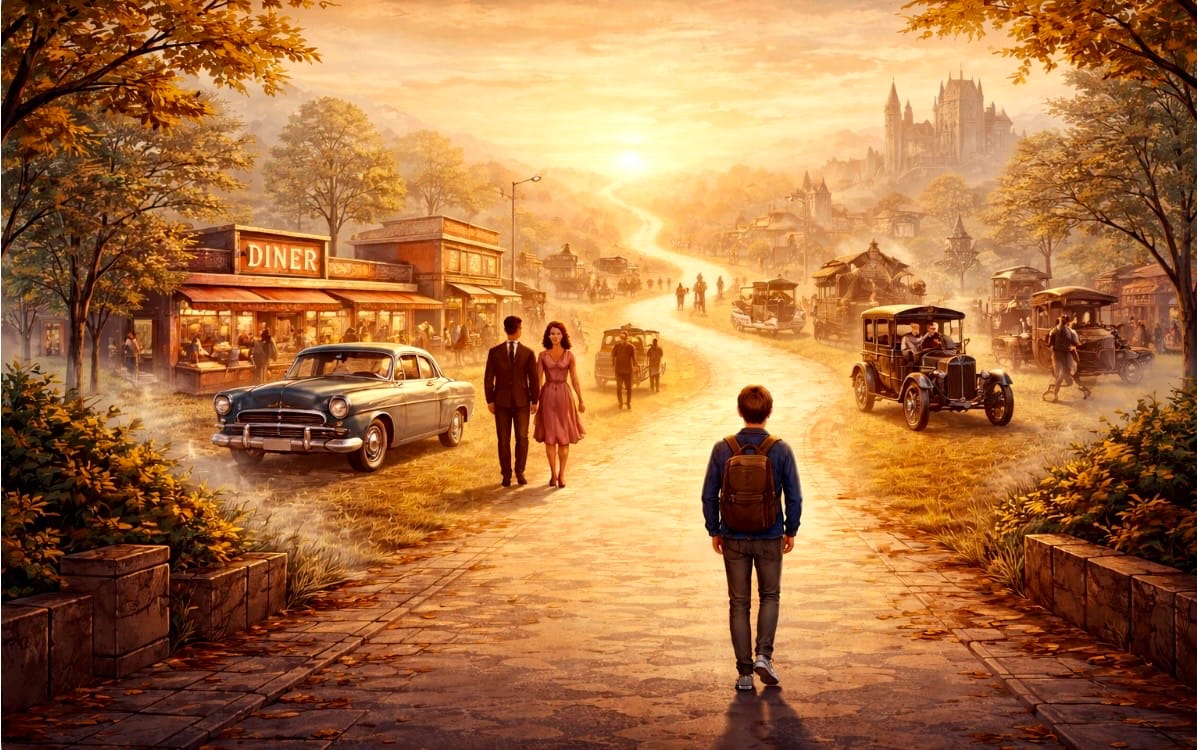
Perspective sneaks up on you. One day you’re just living your life, and the next you realize you’ve outlived phone booths, rotary dials, rabbit-ear antennas, reel-to-reel tape recorders, and the idea that long-distance calls should be brief because they cost money.
I remember when “the cloud” was just something you worried about ruining a picnic. Time compresses in strange ways. Childhood summers felt endless; decades now slip by like weekends. We used to circle answers in encyclopedias. Now we argue with strangers who have Googled half a headline. Now AI helps me write this.
And yet, for all the technological fireworks, people remain stubbornly the same. We still worry about being loved. We still want our work to matter. We still tell the same jokes, just on newer platforms. The tools change. The insecurities don’t. Neither does the need to laugh at ourselves, preferably before someone else does.
Which leaves me with this: living across decades, centuries, and millennia doesn’t make me feel old so much as briefly entrusted with a long view. I’ve seen enough change to know more is coming, and enough sameness to know we’ll muddle through it the same way we always have — telling stories, making jokes, and occasionally claiming we wrote the very first song.