And now, the fight against “DEI bike lanes”
I went to the poll and while I saw there is general, generic support for bike lanes, what I did not see was this question: “Do you want a bike lane installed on your block?”

It is what you call a quandary.
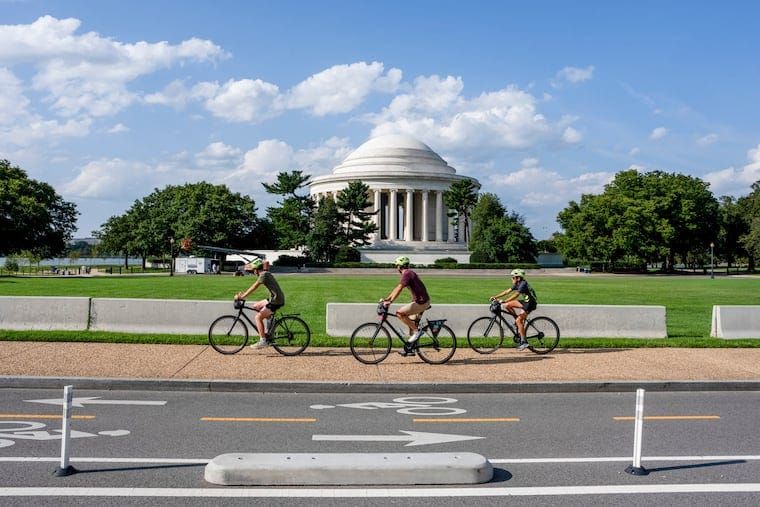
The Trump Administration is apparently making moves against bicycle lanes, an idea I applaud, but it is motivated by ridiculous reasons, revoking federal grants for “DEI bike lanes.”
DEI bike lanes?
Where does that come from?
That’s why I am returning to a topic similar to one I wrote about just a few days ago.
The DEI notion apparently comes from the Department of Transportation that told NPR that liberals believe “that everyone should ride a bike to their shoebox-sized apartment to eat crickets to achieve a phony climate agenda.”
That is a funny line, but it is ridiculous.
Transportation Secretary Sean Duffy is closer to sanity when he says that bike lanes cut into space used by cars and trucks, with the result of “longer travel times and wasted fuel.”
In reporting done for The New York Times, reporter Richard Fausset writes about what he says (without substantiation) is the “bike-lane revolution,” but he did eventually manage to squeeze in a few facts that not everyone is ga-ga over two-wheelers.
The nuttiness began in California, of course, when Gov. Ronald Reagan signed a law that for the first time allowed governments to create bicycle lanes.
In his role as media cheerleader, Fausset reports that 76% of Americans support bike lanes “in and around places where they live, including 66% of Republicans,” according to a 2025 YouGov poll.
As I have been writing about this topic for a long time, I was more than a little suspicious.
I went to the poll and while I saw there is general, generic support for bike lanes, what I did not see was this question: “Do you want a bike lane installed on your block?”
Not in the “community, “ but right on your street.
I guarantee you the result would be entirely different if that were asked.
At least in Philly, where no one ever has officially asked that question, but unofficially, whenever a bike lane is announced, there is always pushback, not brass bands.
Years ago, I unsuccessfully challenged the Bicycle Coalition of Greater Philadelphia to subject bike lanes to a citywide referendum.
Ask this question: Do you want a bike lane (and the loss of parking) installed on your block?
The Coalition dropped down a manhole. It would be a loser, and I will tell you why.
Bicycle riding may be fun, but it is a cult and has never developed into even a minor transportation resource. Bike lanes are like airports. Everyone wants to live “near” an airport, but no one wants to live next to one with the sound of planes taking off and landing.
When bike lanes were rolled out in Center City about 15 years ago, Mayor Michael Nutter made a prediction/hope/wish that in a decade, 6% of Philadelphians would commute by bike.
It’s now 15 years and the percentage of bike commuters has never reached even half that. It usually hangs around 2%, higher in summer, lower in winter.
That is true even as the city keeps adding bike lanes, stubbornly doubling down on a failed policy because it seemed like a good idea, once upon a time.
In a reversal of “Field of Dreams,” if you build it, they will not come.
So Trump is looking for ways to cut funding for bicycles lanes, and I am all for that, but not for the stated DEI reason that is just dumb. It reminded me of another Transportation Secretary, Pete Buttigieg, who found that some bridges were racist.
“Hostility to bike lanes, in fact, can be found in surprising places,” the Times grudgingly admitted (at the end of a long story).
Such as navy blue Boston, where progressive Mayor Michelle Wu laid down miles of bike lanes, but had to slow down because of blowback from “regular” people.
You might be surprised at who one of the “regular” people is.
That would be Reggie Stewart, the climate and environmental justice chairperson of the Boston NAACP.
“You’re taking away parking and adding to an already congested corridor,” said Stewart.
“Mayor Wu falls into that category of liberals who think they know best without having real conversations with the people affected.”
And this Stuart agrees with that Stewart.