Negotiating with Iran is the wrong choice
On his Saturday, June 20 show, referencing the peace plan, Smerconish concluded it was the best of three bad choices. I disagree.

Based on positions he takes on his Saturday morning CNN show, I find Michael Smerconish to be a fair arbiter of almost all the subjects he chooses to cover.
I have known him for some 30 years, going back to when he had a show on WWDB and then WPHT, a/k/a right-wing radio. He was conservative then — he actually worked as a HUD regional administrator under President George H.W. Bush. Now, like me, he is a centrist.
Through his lawyerly analysis, and his informed guests, I almost always learn something new from his show. And Smerconish, like me, takes fire from both Left and Right because his opinions are sometimes Left, sometimes Right. He may be the only CNN personality who is capable of praising President Donald J. Trump for an action, which gives cramps to some in his generally liberal audience who condemn him as a shill, or “carrying water” for Trump.
The only thing Mike is carrying is a torch for truth and fairness, commodities in short supply.
We had identical, if somewhat squishy, opinions about the war with Iran.
We believed starting it was a mistake, but not winning it would be an even bigger mistake. Now, Mike has taken a step back.
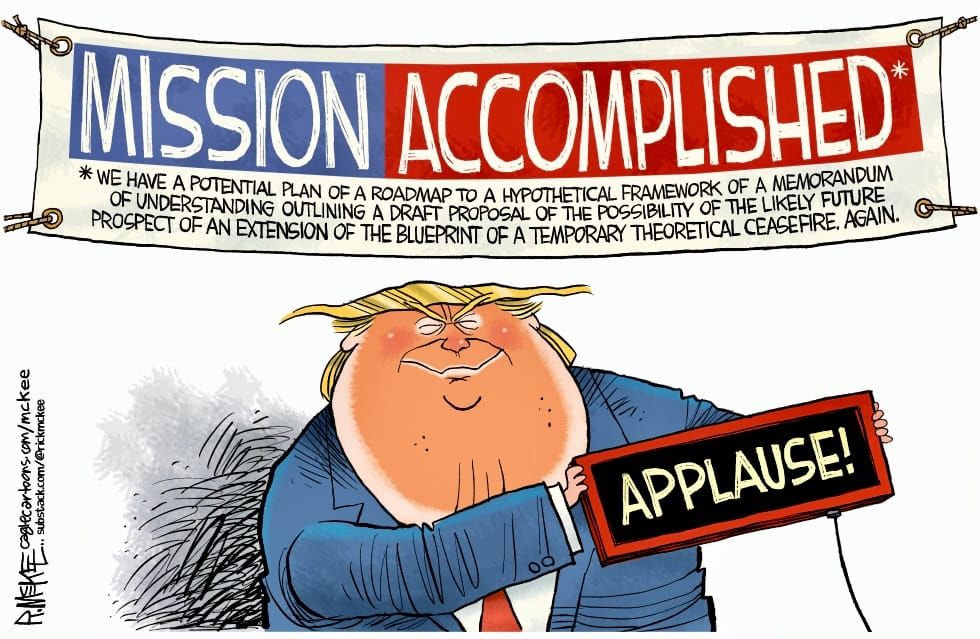
On his Saturday, June 20 show, referencing the peace plan, Smerconish concluded it was the best of three bad choices.
I disagree.
Here are the alternatives, as outlined by Smerconish’s guest, Adm. James Stavridis, the former NATO Supreme Allied Commander:
1- Trump could have pulled a Pontius Pilate, washed his hands of the mess (that he created), and walked away, pulling all U.S. forces out.
2- He could have resumed massive bombing, which Smerconish feels won’t work, and Americans have no stomach for boots on the ground.
3- Negotiate.
“I think he picked the best of three really bad options," said Stravidis, agreeing with Smerconish.
I might agree, except for the glaring omission of alternative #4 — keep up the blockade of Iranian ports, which is strangling Iran’s economy. Prices are soaring, especially for food, jobs are scarce.
At some point, the military can’t be paid, electricity and services can’t be provided.
The big drawback to #4? Patience. Americans don’t have it and the mullahs do. Continuing slow strangulation would keep gas and other prices high in the U.S. Americans are grousing and midterm elections are approaching.
Asking Americans to be patient and bite the immediate price bullet for later rewards could be manageable, but Trump does not have the stature and ability to rally the American people to “pay any price, bear any burden, meet any hardship” as John F. Kennedy once did.
—-
Earlier this month, Smerconish suggested that Trump go to Congress to get authorization for the use of force. That likely would mean more bombing, which Smerconish now thinks won’t work.
That’s debatable. And on Saturday, Iran reneged by shutting the Stait of Hormuz, which had opened a crack. It blamed Israel for breaking the ceasefire for attacking Lebanon; Israel responded that it retaliated against a Hezbollah attack. Count on more, not less, of this.
My idea (posted after Iran threatened to widen the war) was to keep up the economic pressure, which might even include the military capture of two Iranian islands — Kharg (the oil export powerhouse) and Oeshm (defense and industrial).
This would not be an attempt to take over all of Iran, with boots on the ground. It would be a limited military operation meant to strangle oil operations.
However, even that might not be necessary.
Something little discussed is the catastrophe that would follow when Iran exceeds its ability to store oil taken from the ground.
This is from Al Jazeera: When an oil-producing nation (such as Iran) reaches maximum storage capacity during a blockade, it is forced to halt extraction. This stops export revenues, risks permanent damage to underground reservoirs, and requires costly, time-consuming infrastructure repairs to restart operations.
Here are some details:
Forced Well Shut-ins: With nowhere to offload crude, producers must halt extraction. This sudden stoppage can damage underground reservoirs and permanently reduce production capacity, costing billions in lost potential revenue.
Damaged Infrastructure: Shutting down or stopping extraction can alter the pressure of reservoirs, allowing water or gas to encroach into producing layers, which makes the oil more expensive to recover later.
Wasted Resources: If producers resort to unsafe or makeshift storage containers to avoid shut-ins, it risks degradation, contamination, and serious fire hazards.
In other words, Iran’s only cash product (other than pistachios) would be crippled for many long years.
We can turn Iran's oil weapon against itsself.
And that would shift the selection of unappealing alternatives to the Iranian tyrants.