A primer: Socialism is not communism
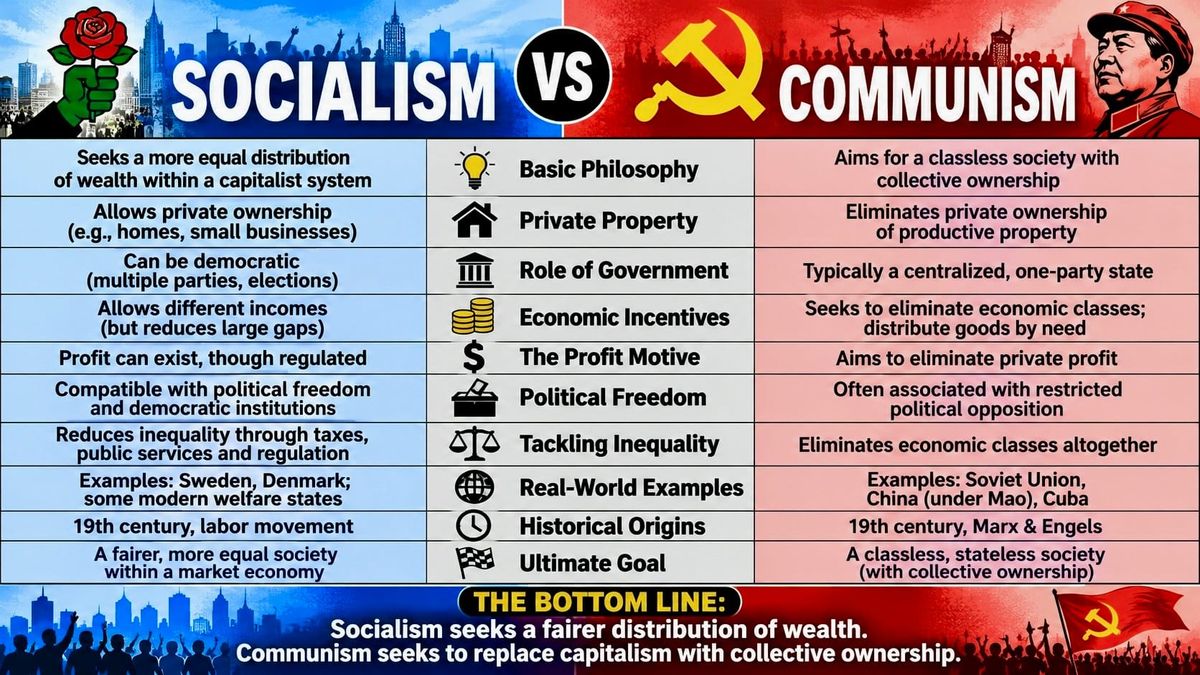
Under socialism, major industries and essential services are owned, operated, or regulated by the government, the public, or cooperatives. Under communism, the state usually owns the means of production.

I haven’t heard the word “communist” thrown around so much since the days of the notorious Republican Sen. Joe McCarthy.
Nor have I heard such utter ignorance about the word “socialist.” President Donald J. Trump uses the terms interchangeably, and he is followed by many in the uneducated MAGA mass. On the Left, I suspect many of those falling in love with socialism don’t really understand it.
Communism and socialism are not interchangeable, and I will explain why in a moment. But first I will acknowledge that parts of the platform of the Democratic Socialists of America do border on communism.
How do I feel about the Democratic Socialists of America? I made myself very clear in this column, which summarizes the differences between communism and socialism. But now, for a deeper dive. . .
Both are economic and political philosophies that seek to reduce economic inequality. However, they differ significantly in their goals, methods, government, private property, and individual freedom. (There are minor exceptions to everything that follows. This is a general overview.)
1. The basic philosophy
Under socialism, major industries and essential services are owned, operated, or regulated by the government, the public, or cooperatives. Under communism, the state usually owns the means of production.
2. Private property
Under socialism, individuals can own homes, cars, personal possessions, and, depending on the particular system, private businesses. Under communism, private ownership of the means of production—factories, large businesses, and productive land—is eliminated. Personal possessions are not necessarily prohibited.
3. The role of government
Socialism usually operates within a democratic government, with elected officials, multiple political parties, and regular elections. In the traditional communist model, the government controls the economy and concentrates power in a single ruling party.
4. Economic incentives
Socialist economies generally allow people to earn different incomes based on their work, skills, and responsibilities. Traditional communism seeks to eliminate economic classes and, theoretically, distributes goods according to people's needs rather than their ability to pay or their individual wealth.
5. The profit motive
Socialism does not necessarily eliminate profit. Private businesses can continue to make money, although government regulations, taxes, and public ownership may limit the role of private enterprise. Communism, in its traditional form, seeks to eliminate private profit derived from ownership of productive capital.
6. Political freedom and democracy
Socialism is compatible with political democracy. Countries with socialist-oriented policies have competitive elections, free speech, independent courts, and opposition parties. Communism, as historically implemented in countries such as the Soviet Union, China under Mao, and Cuba, is associated with one-party rule, restrictions on political opposition, and limitations on individual freedoms. In short, communism pretends to love people, but hates giving them freedom.
7. How each system approaches wealth inequality
Socialism attempts to reduce inequality through progressive taxation, public services, social benefits, labor protections, and sometimes public ownership of industries. Communism seeks to eliminate the underlying economic class structure altogether by abolishing private ownership of productive resources.
8. Examples in the real world
Countries such as Sweden, Denmark, and Norway are frequently described as socialist, but that description is technically misleading. They are capitalist market economies with extensive welfare systems, strong labor protections, and high taxation. Their free people enjoy a high standard of living.
The Soviet Union was the most prominent historical example of a communist state. China, Vietnam, and Cuba are governed by communist parties, although their actual economic systems differ considerably, with China and Vietnam incorporating substantial market-based reforms. Their people are not free and have a lower standard of living than in the West.
Socialism seeks to reshape capitalism into a more equitable form. Communism seeks to replace capitalism with a classless society.
Closing hot take: Republicans and Democrats have more in common than socialists and communists.