Social Security is reeling but relief is simple
And here is the solution: Remove the income cap.

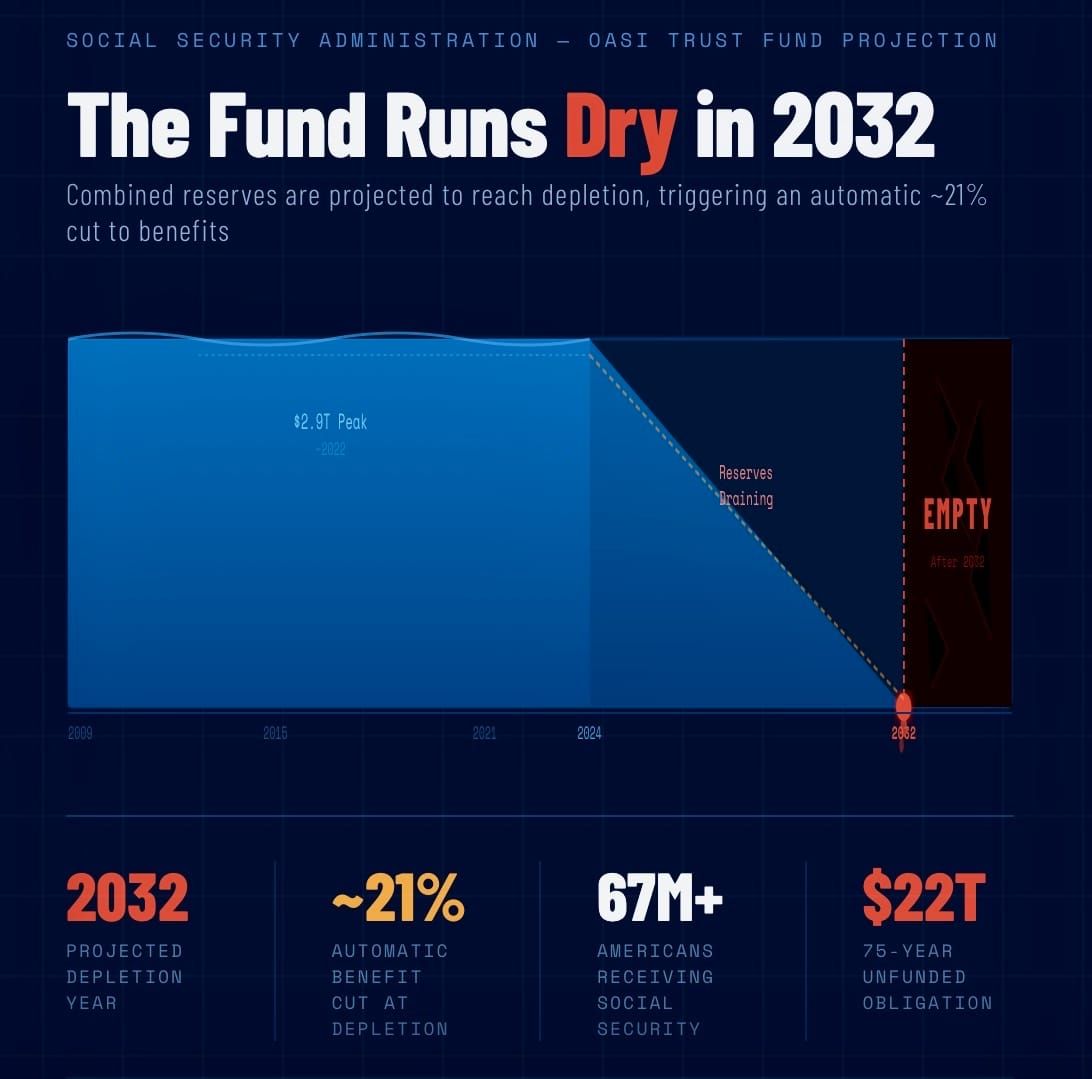
Bad news for seniors, and disabled people.
The “expiration date” for Social Security — retirement, and disability — has been moved forward to 2032.
This does not mean the trust funds will “go broke,” which has been erroneously reported. What it does mean is that SocSec will be able to pay only 79% of scheduled benefits. (Medicare would be unable to pay full benefits one year later, in 2033.)
It’s kind of like a boxer who caught several shots to the chops, and has taken a 6 count, but who still can rebound to win the fight.
One reason, ironically, for the frightening new projection is the Social Security Fairness Act, which started in January 2025 and increased benefits for some 3 million recipients. When more people are taking out of the pot, the contents of the pot shrivel.
When Social Security began in 1935, there were 42 workers for every beneficiary. Now, there are less than 3 workers for every beneficiary. And dropping.
Social Security is funded by a 6.2% payroll tax paid by both worker and employer. (Another 1.45% is added to fund Medicare.)
Here is the gimmick, and also the cure.
The tax is applied on only the first $184,500 earned this year. This cap increases every year.
It is estimated that about 80% of Americans earn less than that. They pay the wage tax every single week.
If you are among the lucky few who earn, say, $9 million, you meet your tax obligation in only one week, and pay nothing the remaining 51 weeks.
Moreover, 23,000 households reported an income of more than $10 million. (That is household income, I could not find a report of individual income.)
That is 23,000 households not paying the wage tax 51 weeks a year.
And here is the solution: Remove the income cap.
This is not a new idea for me. I wrote a column about it way back in 2010, and had a LaSalle economics prof vouch for my math. The column talked about some other fixes recommended by some commission that got as far as a Ford in axle-deep mud.
Here’s the perplexing part: Since removing the cap would affect very few Americans — so rich they don’t need Social Security benefits — why the hell hasn’t Congress enacted cap removal? I mean, aside from the usual inertia, partisan bickering and bowing to the rich?
Democrats have taken a beating lately for not supporting issues that make sense to a majority of voters. This one does, because we’re all in Social Security, and removing the cap would be cheered by 80% of the voters.
I think it would be a great issue, and I don’t care if Dems do it, or Republicans. Won’t someone do it?
The light at the end of the tunnel is a freight train heading toward us. The SocSec system needs to be fixed much earlier than 2032. There is a simple fix.
It must be done or there will be political hell to pay.
——
This is an updated version of a column that ran here 6/25/25.