Banning billionaires will make YOU how much better off?
Let’s imagine our Socialist Summer leads to a (peaceful) democratic revolution that in 2028 produces the election of Ms. Ocasio-Cortez as (all together now) our first Latina Socialist President, with a Socialist majority in Congress.

The idea of “tax the rich,” or the less aggressive “redistribute wealth” is appealing to many, especially when times are tough for a majority of Americans who don’t care that the stock market reached new highs, because so did the price of gasoline.
Remember future President Alexandria Ocasio-Cortez’s gown at the 2021 Met Gala?
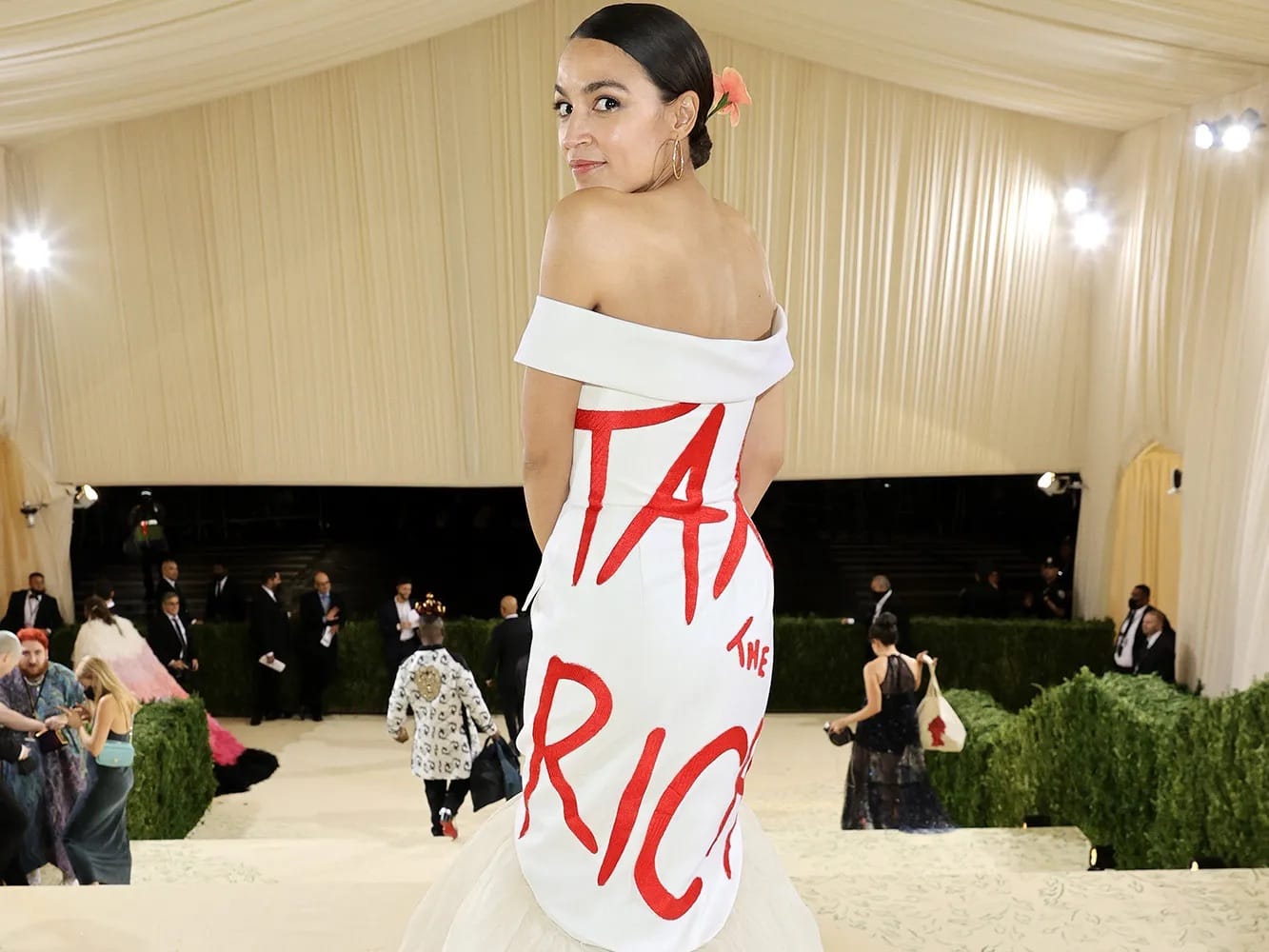
Sure, you do.
A lot of Americans endorse that idea (as long as they are not included in the “rich” category).
But will it work, really?
I mean, really?
Let’s imagine our Socialist Summer leads to a (peaceful) democratic revolution that in 2028 produces the election of Ms. Ocasio-Cortez as (all together now) our first Latina Socialist President, with a Socialist majority in Congress.
Meaning they can pass any bill they like.
And the bill they like (still imagining now) is to strip every dime from every billionaire in the United States and redistribute that mountain of cash to every American. You have heard some Socialists talk about “banning billionaires.”
What would that put in everyone’s pocket?
I asked Gemini AI.
Here’s what it told me:
$23,000 to $24,000 per person if given to every man, woman, and child in the United States. (Claude AI estimated $25-27,000.)
Maybe enough to buy a car, or pay off some debts, but not enough to buy a house.
This calculation is based on an estimated total U.S. billionaire wealth of $7.9 trillion to $8.2 trillion (held by roughly 930 to 990 individuals) divided across a national population of approximately 342.5 million people (or ~260 million adults).
The Breakdown
Illiquidity of Wealth: Billionaire fortunes are not held as cash sitting in checking accounts. They consist almost entirely of ownership stakes in public and private companies, real estate, patents, and investment funds.
Market Impact: Liquidation of billions or trillions of dollars in corporate shares simultaneously would drastically drive down asset and stock prices, substantially reducing the final cash value collected during redistribution. That’s called a Catch-22.
One-Time Event: This redistribution represents a single, one-off wealth transfer rather than a recurring annual payout or income stream.
—-
So, really, how much better off would you be?
Tell the truth.
We do have a yawning gap between the haves and have littles, but is breaking the billionaires the best policy? Be honest.
Before my friends on the Left have a stroke, let me be clear: I am not saying don’t tax the rich. I am in favor of moving the top tax bracket from the current 37% to something, mmm, higher.
How much higher?
Let’s say 50% and no loopholes.
Before my friends on the Right have a stroke, remember it was 92% under Ike (although few if any actually paid 92%).
Hell, I’m even open to Steve Forbes 20% flat tax, providing everyone above the poverty line paid it. (He actually proposed 17%.)
In 2025, IRS collected $2.7 trillion in income tax. Under a hypothetical 20% flat tax, the take would have been 25% higher, at $3.2 trillion.
I know many feel the flat tax, which eliminates almost all deductions, favors the rich. That’s at least partially true, but so is this — a family of four would pay no tax on the first $36,000 of income.
My main point is breaking the billionaires is not the solution.
We do need more revenue, and/or decreased spending, in order to start munching on our astronomical $40 tillion national debt that most politicians are not talking about, as I have mentioned before.
As Americans, we need to have some serious conversations about the economy rather than bumper sticker ideas.