The Postal Service moves to help Trump stop mail voting
In recent elections President Donald J. Trump voted by mail, but he wants to end it because he mistakenly believes mail voting is “cheating.”

Do you like voting by mail?
California, Colorado, Hawaii, Nevada, Oregon, Utah, Vermont, and Washington all use mail as the standard system, although you can vote in person if you want.
I always voted in person until 10 years ago when I busted my quadriceps and was pretty much immobile during an election. That was my first (reluctant) mail vote. It was not my last.
I still prefer to vote in person on Election Day as I feel it satisfies one of the few “duties” that are asked of citizens, I like seeing my neighbors at the polls and I worked at the polls for a couple of years when I was a Democratic committeeman.
Despite how I feel, a majority of Americans like voting by mail, more Democrats than Republicans. In the 2024 election, nearly one-third of all voters voted by mail.
In recent elections, that included President Donald J. Trump, but he wants to end it because he mistakenly believes mail voting is “cheating.”
It is true Democrats have an “advantage” in mail-in balloting because far more Democrats vote by mail than Republicans. Only 32% of Republicans, according to Pew Research, favor mail voting, opposed to 83% of Democrats.
That means that when the “late” returns — meaning by mail — are counted, Democrat candidates can surge because so many more mail ballots are cast by Democrats.
This should be easy to understand, but for MAGA, it is not. To them, it is “proof” of fraud.
A few days ago, the U.S. Postal Service published proposed regulations to carry out a Trump executive order that would restrict mail voting, or end it in some states. Postmaster General David Steiner has embarrassed Benjamin Franklin, who founded the post office as a nonpartisan service for Americans. (In truth, Ben had a financial motive — the service distributed printed material he published.)
Before the post office accepts ballots into the system, under the proposed regs, the agency would review every envelope for compliance with the new standards, including by checking the recipient was enrolled with the Postal Service.
What could go wrong?
Oh, I don’t know. A few days ago the Postal Service returned to me a letter I misaddressed to a friend, which was mailed November 26. Almost nine months to return to sender?
All 50 states allow some form of mail-in voting, but if the regulations are enacted, the post office would not deliver mail ballots to states that have not furnished lists of voters demanded by Trump. The Constitution empowers the states, not the federal government, to control voting rules.
Trump’s executive order was blocked by federal courts this summer, but Monday the U.S. Supreme Court, which has been kept busier than a towel boy in a Turkish bath by Trump’s ceaseless attempts to eliminate guardrails to Presidential power, gave his executive order a green light to proceed, but it remains open to challenge.
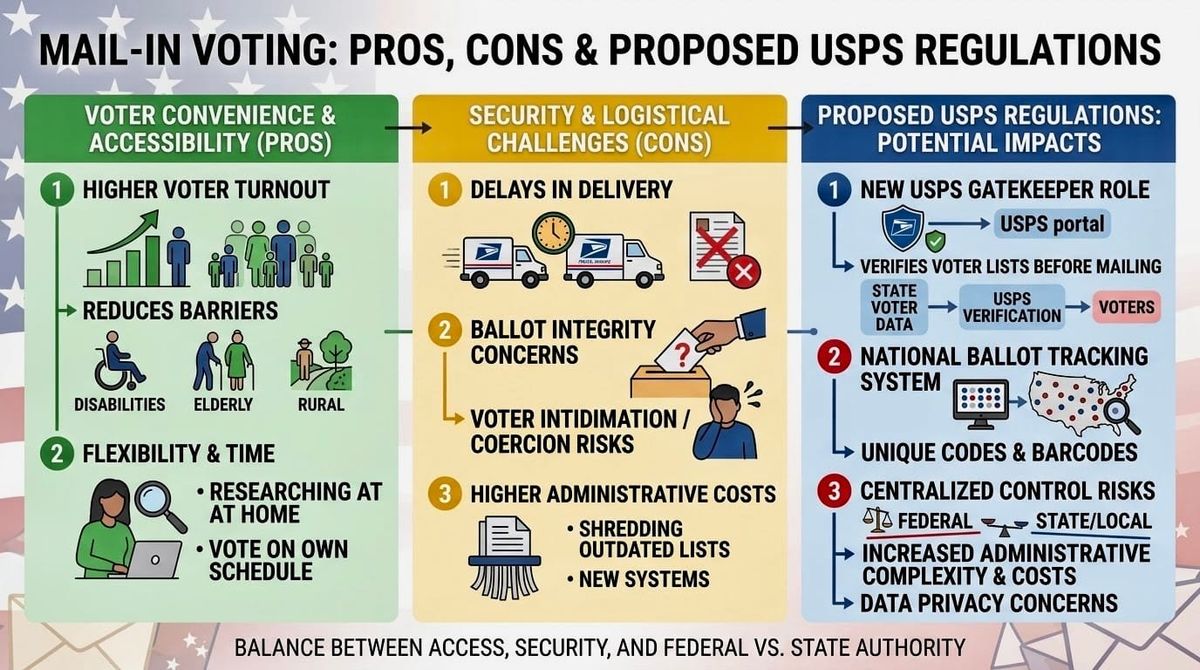
For the purposes of intelligent discussion, with help from ChatGPT, here are the potential advantages and disadvantages of mail-in voting:
Advantages
- Greater convenience: Voters can fill out ballots at home and return them by mail or at secure drop boxes.
- Higher participation: Research generally finds that universal vote-by-mail produces modest increases in voter turnout, particularly in local and midterm elections, though the effects vary by state and election.
- Reduced Election Day lines: When more people vote by mail there are shorter lines at polling places.
- Resilience during emergencies: Mail voting can continue during public health emergencies, natural disasters, or other events that disrupt in-person voting.
Disadvantages
- Slower vote counting: Mail ballots often require signature verification and other processing steps. Final results take longer because ballots arriving after Election Day can be counted if they meet legal deadlines.
- Risk of ballot rejection: Ballots may be rejected due to missing signatures, signature mismatches, late arrival, or other technical issues. Many jurisdictions have “cure” processes that allow voters to fix certain problems.
- Mail delivery concerns: Postal delays or lost mail can prevent ballots from arriving on time, although voters in many areas can instead use official drop boxes.
- Administrative costs and logistics: Running a mail-voting system requires investments in printing, mailing, ballot tracking, signature verification, secure storage, and voter education.
For me, the pros outweigh the cons. How about you?